
Citrine: Natural Citrine, Heat-Treated Amethyst & the Story Behind the Sunshine
Hi Sunflowers,
Citrine has always had a particular kind of warmth about it.
Its golden colours can range from pale yellow and champagne through honey, golden orange and deep reddish orange. It is a beautiful and durable variety of quartz, and it has been treasured in jewellery for centuries.
But there is a fascinating story hiding behind that sunny colour.
Much of the Citrine sold today is not naturally formed Citrine at all. It began life as Amethyst and was heated to change its colour.
That doesn't make heat-treated Amethyst "fake". It is still genuine quartz, and heat treatment is a recognised gemstone treatment. What matters to us at Sunflower Hollows is simply that we call it what it is.
So let's take a closer look at Citrine, where its colour comes from, why people began heating Amethyst, what Smokey Quartz has to do with the story, and why natural Citrine has captured my attention so completely.
What Is Citrine?
Citrine is a yellow to orange variety of quartz, with the chemical formula SiO₂.
Quartz is one of the most abundant minerals on Earth, but naturally occurring Citrine is comparatively uncommon. Its colours can range from pale yellow and brownish yellow through golden, orangy yellow and reddish orange.
Trace elements and defects within the quartz structure are responsible for its colour, with iron playing an important role.
Citrine has a Mohs hardness of 7, giving it the same general durability we associate with other quartz varieties such as Amethyst, Rose Quartz and Smoky Quartz.
The name "Citrine" comes from the French word citron, meaning lemon. It is a rather perfect name for a crystal whose colour can resemble everything from a pale lemon peel to warm golden honey.
And since I'm currently teaching myself French, I am particularly delighted by this little piece of crystal etymology.
How Does Natural Citrine Form?
Natural Citrine forms through geological processes that create the right combination of chemistry, temperature, pressure and conditions within quartz.
Its colour is not simply a matter of "yellow iron". Quartz colour is surprisingly complicated, involving trace elements, defects in the crystal structure, radiation and the way those components interact.
This is one reason natural Citrine can look so different from one specimen to another.
Some natural specimens are pale and transparent. Others are warm golden, brownish or reddish orange. Some contain interesting inclusions or colour zoning.
In other words:
Natural Citrine does not have one single look.
And that is something I have come to appreciate more and more.
So Why Do People Heat Amethyst?
Here's where the story gets really interesting.
Amethyst and Citrine are not completely different minerals. They are both varieties of quartz.
Amethyst is purple quartz.
Citrine is yellow-to-orange quartz.
Under the right conditions, heating Amethyst can alter the colour centres responsible for its purple colour and produce yellow or orange colours associated with Citrine.
The process is not as simple as "put purple crystal in an oven and get yellow crystal", though.
The starting material matters. So do its chemistry, colour, inclusions, zoning, temperature and heating time.
Different Amethysts can respond differently to heat, producing different shades and sometimes unexpected results.
This is one reason that heat-treated material can have such a wide range of appearances.
Humans May Have Been Doing This for Thousands of Years
This might be my favourite part of the entire Citrine story.
Modern commercial heat treatment is often discussed as though someone in the gem trade eventually discovered that Amethyst could be turned yellow.
But archaeological research from the Serra dos Carajás region of Brazil tells a much older story.
Researchers studying prehistoric sites in the region found Amethyst and other quartz associated with ancient combustion areas. Their experiments and archaeological evidence indicate that prehistoric people were heating Amethyst and transforming it into yellow Citrine-like material.
Some of the archaeological evidence dates to approximately 9,600 years ago.
That means humans may have been deliberately changing the colour of Amethyst through heat thousands of years before the modern gemstone industry existed.
And there is an especially fascinating detail: experimental work showed that the colour transformation could be achieved using controlled heating in ceramic vessels and fires.
So while modern gemstone treatment uses controlled equipment, the basic discovery may be ancient:
Quartz + heat can change the story written in its colour.
We should be careful not to claim that prehistoric people were doing exactly the same thing as today's commercial Citrine producers. The archaeological evidence comes from a particular region and reflects specific prehistoric practices.
But the possibility that people were intentionally transforming Amethyst into Citrine thousands of years ago is extraordinary.
Why Did Heat-Treated Citrine Become So Popular?
There is a very practical reason.
Natural Citrine is relatively rare, while Brazil has enormous deposits of Amethyst.
If you have abundant Amethyst that isn't particularly desirable in its original colour, and you discover that controlled heating can transform suitable material into an attractive yellow or orange colour, you suddenly have a commercially useful gemstone treatment.
Researchers studying modern Brazilian mining have documented exactly this sort of economic motivation.
At the Alto Bonito area of the Serra dos Carajás, a major Amethyst occurrence was exploited from the early 1980s. The abundance of Amethyst affected its commercial value, and miners developed heat treatment as a way of transforming it into Citrine and creating a new marketable product.
So the history isn't simply:
"Someone wanted to make fake Citrine."
It is much more interesting:
"People discovered that a plentiful quartz material could be transformed into another beautiful colour variety."
Heat treatment became a practical part of the gemstone trade.
What Actually Happens When Amethyst Is Heated?
Amethyst's purple colour is associated with colour centres and trace elements within the quartz structure, particularly iron.
When the material is heated, those colour centres can be altered.
At appropriate temperatures, the purple colour can disappear and yellow or orange colours can develop.
Experimental research has shown that the transformation depends strongly on the original material and the heating conditions.
One study found distinct colour-change stages as Amethyst was heated, with Citrine-like colours developing at higher temperatures. Other gemological experiments have demonstrated that Amethyst from different sources can behave differently when heated.
This is why there isn't one universal temperature that simply turns every Amethyst into Citrine.
The crystal's starting chemistry matters.
The Smokey Quartz Plot Twist
And here is something I absolutely wanted to include because it surprised me too:
Smokey Quartz can also be heat treated to produce Citrine-like colours.
Most conversations about heat-treated Citrine focus on Amethyst, but gemological research has documented yellow and lime-coloured material produced by heating Smokey Quartz.
Older gemological literature also records commercial Citrine being produced from both Amethyst and Smokey Quartz.
So "heat-treated Citrine" isn't always as simple as:
purple Amethyst → orange quartz
The starting quartz matters.
And this is one reason I don't want to teach people that they can identify natural Citrine simply by looking at whether a piece is pale, dark, orange or brown.
Quartz is much more complicated than that.
Can You Tell Natural Citrine From Heat-Treated Amethyst Just by Looking?
Sometimes there are clues.
But appearance alone is not a reliable way to prove whether a specimen is natural or heat treated.
Certain colour patterns, inclusions, crystal habits and other features can provide useful clues to an experienced gemologist.
Some heat-treated Amethyst can show characteristic features associated with the original material, and researchers have studied inclusions and microscopic characteristics that can help distinguish treated material.
But there is no simple rule such as:
"Bright orange = heat treated."
or:
"Pale yellow = natural."
Natural Citrine can occur in a range of colours, and treated quartz can also have a wide range of appearances.
Reliable identification may require gemological examination and, in some cases, advanced testing.
So if you see a gorgeous golden crystal, the honest answer isn't always:
"I can tell you exactly how this got its colour just by looking at it."
Sometimes the responsible answer is:
"There are clues, but we can't be certain from appearance alone."
And I think that's an important lesson in crystal collecting.
Three Pieces of Quartz, Three Stories
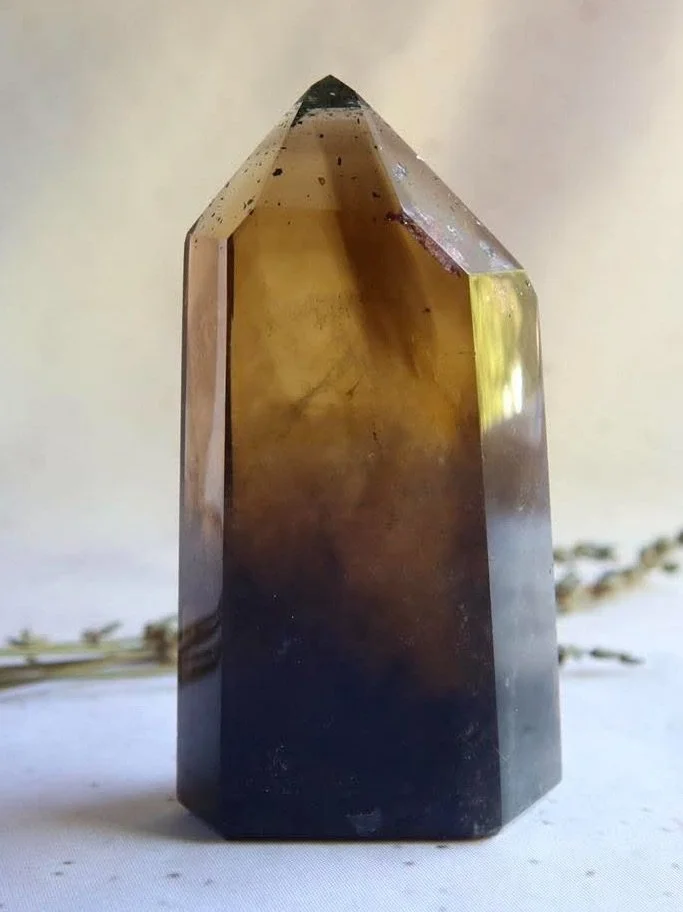
Natural Citrine with Smokey Quartz and hematite-related features
This is my own Citrine specimen, and it is actually part of why I became so interested in Citrine in the first place.
It doesn't look like the bright yellow Citrine that many people immediately picture.
It has smoky, earthy areas, beautiful internal variation and a depth that makes you want to keep looking into the crystal.
This is a lovely reminder that natural Citrine can have character.
It doesn't need to be perfectly clear or uniformly yellow to be beautiful.
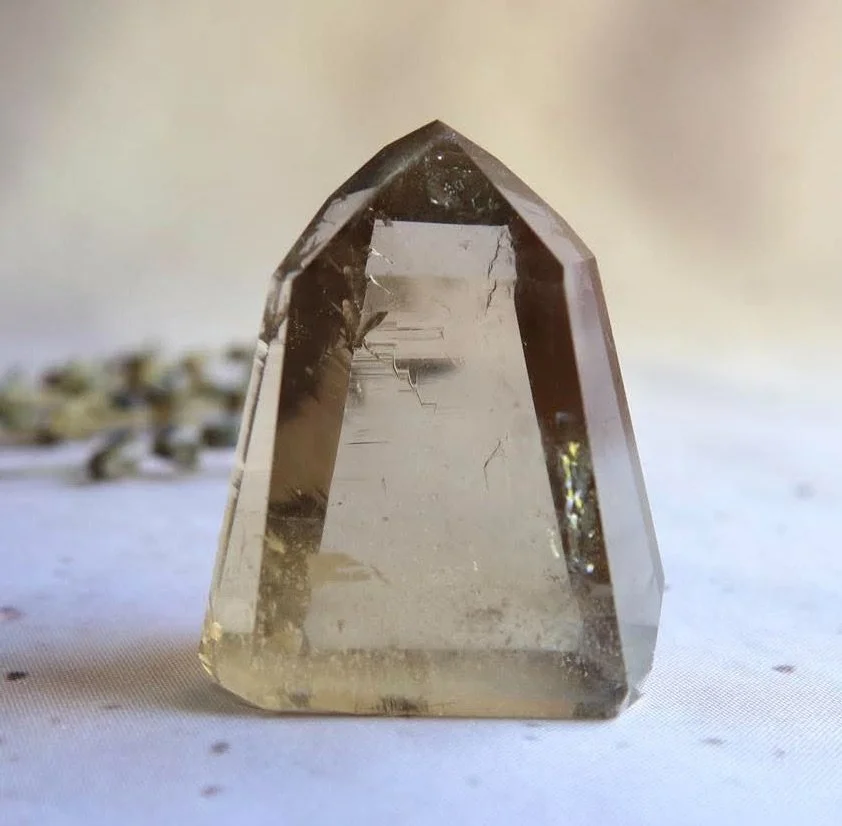
Natural Citrine
Our second specimen will show a different appearance of naturally occurring Citrine.
Having two natural specimens beside each other is important because it demonstrates something that photographs of a single specimen cannot:
Natural Citrine is variable.
There isn't one "correct" natural Citrine appearance.
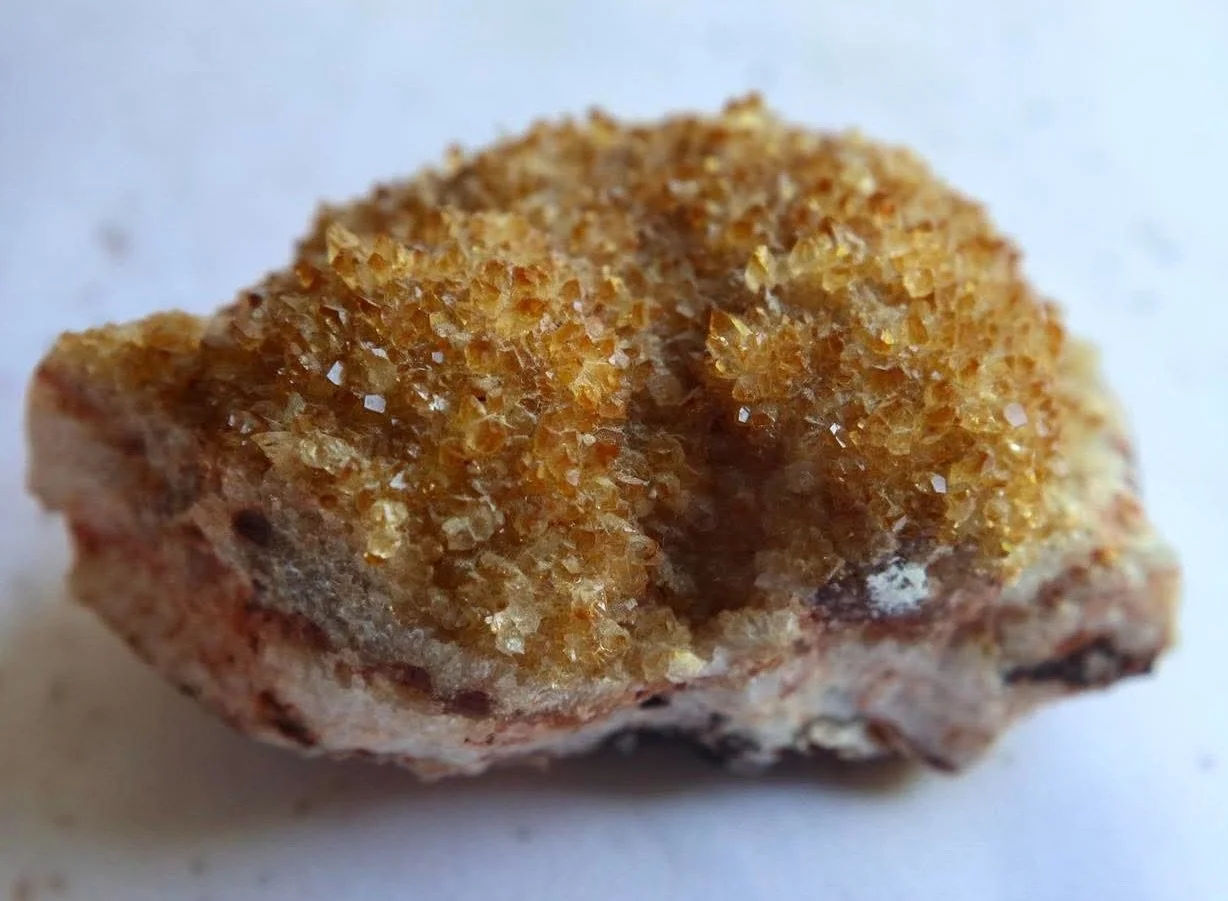
Heat-Treated Amethyst
And then we have our deliberately dramatic orange specimen.
This material began life as Amethyst and was heat treated to change its colour.
It is still quartz.
It is still a genuine mineral specimen.
It simply has a different history.
Three pieces.
Three stories.
One fascinating mineral family.
Is Heat-Treated Amethyst "Fake Citrine"?
This is where I think the conversation often becomes unnecessarily heated.
No, heat-treated Amethyst isn't fake quartz.
It is genuine quartz that has undergone a treatment that changes its colour.
Heat treatment is a recognised gemstone treatment and is widely used throughout the gem industry.
The important distinction to us is how the material is represented.
If a piece began life as Amethyst and was heat treated, calling it Heat-Treated Amethyst tells the customer exactly what they're buying.
Calling it Natural Citrine tells a very different story.
At Sunflower Hollows, we would rather tell you the crystal's actual story.
Not because one material is "good" and the other is "bad".
Simply because we think you deserve to know.
Why Sunflower Hollows Uses the Real Name
I absolutely adore Citrine.
In fact, lately I've found myself especially drawn to natural Citrine. There is something about its natural golden colour, variation and inclusions that really captures my attention.
Interestingly, I've never experienced the same attraction to the intensely bright orange material that I often see in heat-treated Amethyst.
That's a personal preference, though.
It isn't a scientific judgement about the value or quality of heat-treated material.
Heat-treated Amethyst is still quartz, and properly disclosed treatment doesn't make it fake.
For Sunflower Hollows, the important thing is simply accurate naming.
If it is natural Citrine, we call it Natural Citrine.
If it is heat-treated Amethyst, we call it Heat-Treated Amethyst.
And if we know a crystal has been treated, we want you to know too.
A Personal Amethyst Story
I actually have a rather strange personal connection to the whole question of heat and quartz.
One of my stalls was once in a shop that caught fire.
Thankfully, my Amethyst survived, while some of the pieces became part of my personal collection after the damage they sustained.
But when I saw it afterwards, it had become noticeably duller.
I remember wondering whether the intense heat might have accidentally transformed it into Citrine.
It didn't.
And now that I've learned more about how complicated the relationship between quartz, colour centres, chemistry and heat actually is, I'm rather glad I didn't assume that "hot enough" automatically meant "Citrine".
A building fire is an uncontrolled environment. We don't know the exact temperature the crystal experienced, how long it was exposed, or what other conditions were present.
It was a rather dramatic demonstration of one thing, though:
Quartz has secrets.
Nature's Two-Tone Wonder: Ametrine
If Amethyst can become Citrine through heat treatment, what happens when nature creates both colours in the same crystal?
You get Ametrine.
Ametrine is quartz containing both Amethyst-purple and Citrine-yellow colour zones in the same crystal.
One of the world's most famous sources is the Anahí mine in Bolivia, which produces natural Amethyst, natural Citrine and naturally occurring Amethyst-Citrine crystals.
When those two colours occur together, the result can be spectacular.
It is one of my favourite reminders that geology doesn't always follow neat little categories.
Sometimes a crystal refuses to choose.
It just becomes both.
And perhaps that's part of what makes Ametrine so lovely. We humans can be like that too. We don't always have to fit neatly into one category or choose just one thing to be. We can carry different sides of ourselves at the same time, and those differences don't have to cancel each other out.
Sometimes, being both is the whole point.
Legends & Lore
Citrine has a long history of use in jewellery, although some of the oldest stories associated with it are difficult to separate from the broader history of yellow quartz and Topaz.
Before modern gemology, Citrine's warm yellow-brown colour sometimes led people to confuse it with Topaz. Historical jewellery from the Victorian era demonstrates that Citrine was certainly valued and used as a gemstone.
Citrine became particularly popular in Victorian jewellery, including Scottish jewellery, where warm golden gemstones worked beautifully with colourful metalwork and other gemstones.
The Legend of Anahí
The story of Ametrine has one of the most romantic legends in the crystal world.
According to the legend, a Spanish conquistador discovered the Bolivian mine that now bears the name Anahí after marrying a princess named Anahí. The mine was supposedly given to him as part of the marriage dowry.
The story says that he later presented the unusual purple-and-yellow gemstone to European royalty.
The mine was then lost for centuries before being rediscovered in the twentieth century.
It is a wonderful story.
But it is important to call it what it is:
a legend.
Historical research suggests that the modern Ametrine trade emerged much later, particularly from the 1970s onward.
That doesn't make the legend any less enchanting. It simply means we can enjoy the story without confusing folklore with proven history.
A Little Citrine Language Lesson
The word Citrine is associated with the French citron, meaning lemon.
And I have to admit, I love that.
A crystal with colours ranging from pale lemon through golden honey and deep orange having a name connected to the humble citron feels rather appropriate.
Traditional Crystal Associations
Citrine has long been associated in modern crystal traditions with:
abundance
prosperity
confidence
joy
warmth
motivation
creativity
optimism
success
generosity
These are traditional and spiritual associations rather than scientifically established effects.
Many crystal enthusiasts choose Citrine when creating rituals or spaces centred around abundance, confidence, creativity and positive intention.
Ways to Use Citrine
Citrine can be incorporated into crystal practices in many simple ways.
Keep it in your workspace
Many people associate Citrine with confidence, motivation and creativity, making it a popular choice for desks and creative spaces.
Carry a small piece
A tumble or small polished stone can be a simple reminder of an intention throughout the day.
Use it during journalling
Hold your Citrine while reflecting on goals, gratitude, confidence or abundance.
Create a crystal display
Natural Citrine is particularly beautiful when displayed where its transparency and colour zoning can be appreciated.
Wear Citrine jewellery
A bracelet, necklace or pair of earrings lets you keep the crystal close while also enjoying it simply as jewellery.
Crystal Pairings for Citrine
Citrine pairs beautifully with many crystals, depending on the intention behind your collection.
Citrine + Tiger's Eye
A warm combination traditionally associated with confidence, courage, motivation and abundance.
Citrine + Clear Quartz
A bright, simple pairing often chosen for clarity, intention and amplification.
Citrine + Smokey Quartz
A beautiful earthy combination, balancing Citrine's golden warmth with Smokey Quartz's grounding associations.
Citrine + Green Aventurine
A popular pairing for intentions around growth, opportunity and abundance.
Citrine + Carnelian
A vibrant combination associated with creativity, motivation and confidence.
Citrine Associations
Chakra: Solar Plexus Chakra
Element: Fire
Zodiac associations: Often associated with Gemini, Aries, Leo and Libra in modern crystal traditions.
These associations vary between crystal traditions, so there isn't one universal correspondence system.
Citrine Care
Citrine has a Mohs hardness of 7, making it reasonably durable for everyday jewellery and display.
However, quartz can still chip or fracture, particularly around points and edges.
For everyday care:
Clean with a soft cloth and lukewarm water.
Avoid sudden temperature changes.
Take care with crystal points and delicate carvings.
Store jewellery separately to avoid scratches.
Avoid prolonged exposure to strong heat.
Because colour stability can vary with quartz material and treatment history, we recommend avoiding deliberately exposing Citrine to high heat.
Final Thoughts
The more I learn about Citrine, the more fascinated I become.
It is easy to look at a golden crystal and see only a beautiful colour.
But behind that colour is a complicated story involving quartz chemistry, geological conditions, ancient human technology, modern gemstone treatment, Brazilian mining history and even a little bit of folklore.
Natural Citrine has its own geological story.
Heat-treated Amethyst has a human story.
Smokey Quartz can enter the story too.
And Ametrine reminds us that sometimes nature creates the most beautiful combinations all by itself.
For me, that is what makes learning about crystals so much fun.
We don't have to decide that one material is "real" and another is "fake" to appreciate the difference.
We can simply learn what each crystal actually is.
And then choose the one that speaks to us.
For me, lately, that has definitely been Citrine.
Blessed be, and happy crystal hunting! 🌻
You can follow us on instagram or facebook for blog updates, crystal knowledge, new products and a little everyday crystal magic
Christine
Sunflower Hollows
It’s not hoarding if it’s crystals.
Until next time, keep exploring, keep learning, and keep a little crystal magic close.
A Note About Crystal Traditions
The traditional meanings, spiritual associations, chakra correspondences, elemental associations and folklore discussed in this article come from cultural traditions and modern crystal practices. They are not scientifically established medical or therapeutic effects.
At Sunflower Hollows, we love exploring the history, geology and traditions surrounding crystals while being clear about the difference between traditional belief and scientific evidence.
-
Yes. Natural Citrine is relatively rare, and most Citrine on the modern market is produced by heat treating suitable Amethyst.
-
No. It is genuine quartz that has undergone a colour treatment.
-
Yes. Naturally occurring Citrine is considerably less common than Amethyst.
-
Certain Smokey Quartz can be heat treated to produce Citrine-like yellow or lime colours.
-
Not reliably. Colour can provide clues, but it is not enough to prove the origin of the colour.
-
No. Natural Citrine can occur in a range of yellow, golden, orange and reddish-orange colours.
-
They are both varieties of quartz. Their different colours and characteristics lead us to classify them differently as gem varieties.
-
Ametrine is quartz containing both Amethyst-purple and Citrine-yellow colour zones in the same crystal.
-
Because we believe customers should know what they are buying. Heat-treated material is perfectly legitimate, but we don't want to present treated Amethyst as naturally formed Citrine.